Ryohin Keikaku Co., Ltd.

Respect for Human Rights

Human Rights Due Diligence

Introduction

Based on its fundamental stance, and in accordance with the Ryohin Keikaku Human Rights Policy established in 2022, we are committed to fulfilling our responsibility to respect the human rights of all stakeholders in the value chain of our business. In line with the United Nations Guiding Principles on Business and Human Rights and the six-step framework of the OECD Due Diligence Guidance for Responsible Business Conduct, we have established a human rights due diligence system. Through this system, we are working to identify and assess the environmental impact of our business activities and supply chain, in addition to preventing or mitigating such impact.

1. Identification and Assessment of Adverse Impacts

In 2023, with the support of external experts, we identified human rights issues that we should address in order to prevent human rights risks from manifesting in the Ryohin Keikaku Group’s business domains, which include the production and sales of apparel, household goods and food. During the process, we also referred to international guidelines, the results of factory audits, and findings from employee engagement surveys. We will prioritize the human rights issues identified, develop roadmaps for relevant divisions and implement initiatives for preventing and mitigating the emergence of human rights risks together with our stakeholders. Going forward, we will continue to monitor the effectiveness of initiatives and review the identification and assessment of adverse impacts on human rights.

Methods of Assessing Human Rights Issues

We have identified high-priority human rights issues by assessing their severity and likelihood in reference to the United Nations Guiding Principles on Business and Human Rights and the six-step framework of the OECD Due Diligence Guidance for Responsible Business Conduct, and with the cooperation of external experts. We conducted the assessment for both our own operations and those of the supply chain.

Salient Human Rights Issues to be Handled with Priority

Our operations
Harassment (including harassment from customers), discrimination, gender-related human rights issues, working hours and the right to access to remedy
Supply chain operations
Labor health and safety, forced labor, child labor, discrimination, the environment, working hours, gender-related human rights issues, consumer safety and the right to be informed, and harassment

2. Prevention and Remedy of Adverse Impacts

Respecting Human Rights in the Supply Chain

We do not own production sites or facilities, nor do we manufacture products. We outsource production to our production partners in Japan and elsewhere around the world. Some factories of production partners are located in countries and regions that are at high risk of modern slavery due to the lack of good governance and weak rule of law, according to reports by international organizations and non-governmental organizations. Therefore, we believe that it is extremely important for us to work on respecting human rights together with our production partners based on compliance with the Code of Conduct for Production Partners.
As part of our engagement with production partners, we have a third-party organization conduct regular on-site audits based on the Code of Conduct for Production Partners, covering issues such as human rights, working conditions and environmental impacts. To date, no instances of child labor or forced labor have been identified in these audits.

Results of Monitoring of Factories

The results of on-site audits and measures for improvement conducted in FY2024/8 are available in the following report.

Factory Monitoring Results

Collaboration with Production Partners

We established the Code of Conduct for Production Partners in order to build good partnerships based on mutual trust and to fulfill our responsibility to ensure fair, safe, and healthy working conditions and consideration for the natural environment throughout the supply chain.
In our supply chain, based on our Code of Conduct for Production Partners, we share with partners our policies on the working environment, respecting human rights, and consideration for the environment, and ask for their compliance. We are also taking steps to ensure that human rights are respected. This code of conduct is distributed (available in Japanese, English and Chinese) to all the production partners who handle our production worldwide. We request all partners to whom we outsource production to sign a pledge to comply with the code of conduct, and contract only with those who do so.
In addition, to deepen understanding of the items in the code of conduct, we regularly hold briefings for business partners and utilize a third-party organization to conduct audits based on the code. We also regularly hold sessions to explain our approach to ESG management, product development and quality control, fostering dialogue with our business partners.

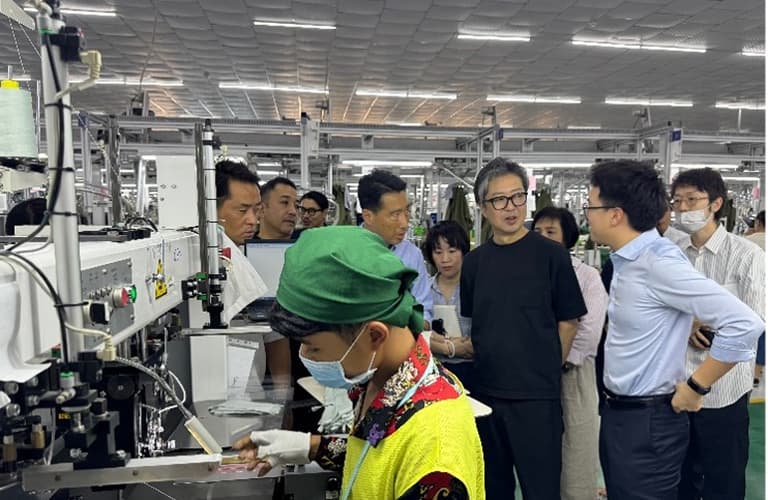
Visiting a production site

To establish partnerships that support sustainable growth, both management and employees regularly visit production areas and factories in Japan and overseas. They are directly involved in the manufacturing and production processes—delving into aspects such as the status of production volume and operation of assembly lines—and maintain ongoing dialogue with local business owners, producers and engineers.

Code of Conduct for Production Partners

List of Production Partners

We believe that enhancing transparency throughout the supply chain is our responsibility to all stakeholders. By disclosing a list of our production partners, we aim to strengthen engagement and promote the development of appropriate working environments.

List of Production Partners

Appropriate Ordering Procedures

We uphold factory working conditions and protect workers’ human rights by placing orders based on appropriate procedures. We also make sure not to set delivery dates in ways that disregard production lead times or frequently change order details, which could lead to the need for excessive overtime work. As such, we strive to adhere to appropriate schedules and quantities when placing orders.

Raw Material Sourcing

For key primary raw materials (cotton, wool, down, linen and wood), we use those that are traceable to their origin to the extent possible.
The organic cotton we use has been confirmed by a third-party organization. This certification is conditional on compliance with labor conditions stipulated by the International Labour Organization (ILO).

Approach to Raw Material Sourcing

Improving Working Conditions through Collaboration with External Organizations

Since 2016, we have been a participant of the Better Work Programme, a partnership between the United Nations International Labour Organization (ILO) and the International Finance Corporation (IFC), with the aim of improving the working environment. We strive to improve the working environment of factories by utilizing Better Work’s service for assessing the status of compliance with the labor standards of each country where factories are located, and in event of any non-compliance, for seeking advice from experts and using training services to resolve the issue.

Participation in Initiatives

Product Development Project in Kyrgyzstan

Ryohin Keikaku has been supporting the One Village, One Product project conducted by the Japan International Cooperation Agency (JICA), and has been developing products together with JICA. We aim to leverage regionally sourced products to help our producers become self-sustaining through knowledge sharing, training and other technical support, which in turn could help them create a self-sustaining business.
The product development project that we have been working on in Kyrgyzstan since 2010 has been approved as a Business Call to Action (BCtA) initiative by the United Nations Development Programme (UNDP), making MUJI the first retailer in Asia to receive such recognition.
We will continue to collaborate with various external organizations to actively promote key initiatives for addressing human rights and environmental issues at production sites.

Donations and Support

Education and Training

・Human Rights Training for Employees

In 2023, Ryohin Keikaku implemented online training sessions for its officers and employees based on the themes of “Business and human rights” and “Respect for human rights expected of companies.” Moving forward, we will regularly conduct training and other sessions on human rights-related topics. In Japan, we conduct anti-harassment training to help employees recognize harassment in the workplace, raise their awareness of prevention, and understand the risks of mental health issues that can arise from it.。

・Training for Employees Involved in the Supply Chain

Since February 2019, Ryohin Keikaku has been conducting training for managers and staff involved in procurement, production management, production planning and quality management within the supply chain. In the training, participants learn about human rights issues in the supply chain and specific examples of factory audit findings. This includes understanding what constitutes modern slavery and severe human rights violations, identifying key areas of concern during factory visits, and the issues occurring in the supply chain along with the responses expected of companies. In August 2024, approximately 200 employees participated in the training.

・Training for Production Partners

Ryohin Keikaku regularly conducts workshops for our production partners to deepen their understanding of the Group’s approach to respecting human rights and the Code of Conduct for Production Partners, as well as to promote efforts to respect human rights throughout the supply chain. Through the workshops, we provide capacity-building support by offering advice on concrete improvement measures, such as by sharing case examples from other companies.
In December 2024, workshops were held for all Tier 1 factories involved in apparel and household goods, with more than 70% of the targeted production partners participating. In addition, in August 2024 workshops were held for approximately 70% of the Tier 1 factories involved in food products.

3. Adverse Impact Monitoring

Monitoring of Production Partner Factories

Ryohin Keikaku utilizes a third-party organization to conduct regular on-site audits of its production partner factories to confirm the status of their compliance with the Code of Conduct for Production Partners. We also share the results of the audits with the factories and work together with them to make improvements in the case of any non-compliant items. Based on improvement reports prepared by each factory, we not only address the issues identified, but also work with the factories to identify the specific activities or procedures—or the lack thereof—that caused these issues, and to determine whether changes to the systems are necessary to prevent recurrence. In the event that a serious human rights violation is identified, such as forced labor or child labor, we work quickly to verify the actual situation and take appropriate action. If corrective action cannot be expected even after we have exercised our influence, we may consider terminating our partnership with the factory, in accordance with the Code of Conduct for Production Partners.

Monitoring Production Partners

Company-wide Engagement Survey

We conduct an engagement survey of employees (including regular employees, contract employees, temporary employees and part-time employees) engaged in businesses in Japan and overseas. Considering the human rights of employees, we also identify issues regarding employee satisfaction and their human rights in the working environment. Survey items include diversity, equality and psychological safety. We conduct the survey annually and make improvements based on the results.

Co-Owned Management and Engagement

4. Information Disclosure

We regularly disclose our initiatives for respecting human rights on our website and through the MUJI REPORT (integrated report) and other communication tools.

Compliance with Laws and Regulations on Respect for Human Rights in Each Country

We adhere to human rights laws and regulations in each country as we develop our business globally.

Statement on the UK Modern Slavery Act and Canada’s Fighting Against Forced Labour and Child Labour in Supply Chains Act

We publish statements in accordance with Section 54 of the UK Modern Slavery Act and Canada’s Fighting Against Forced Labour and Child Labour in Supply Chains Act. This statement outlines our efforts to prevent modern slavery (including forced labor and child labor) and human trafficking within our business operations and the supply chain.

Modern Slavery Statement (2024/8)
Human Rights Due Diligence | Ryohin Keikaku Co., Ltd.