Ryohin Keikaku Co., Ltd.

Governance

Assessment of Effectiveness of the Board of Directors

Assessment of Effectiveness of the Board of Directors

The Board of Directors conducted an analysis and assessment of the Board’s effectiveness based on the corporate governance policy set by the Company. The results of that assessment are summarized below.

Summary of Assessment Process

  1. The Board of Directors set the following evaluation categories it believes are necessary for assessment of the Board’s effectiveness and conducted a survey of and interviews with directors and corporate auditors.
    <Evaluation Categories in the Questionnaire>
    1. Composition of the Board of Directors
    2. Operation of the Board of Directors
    3. Enhancement of discussions at Board of Directors meetings
    4. System supporting the Board of Directors
    5. Enhancement of relationship with shareholders and other stakeholders
    6. Other comments
  2. The Board secretariat summarized the results of its assessment of directors and corporate auditors using the above questionnaire format and interviews.
  3. Based on these results, the Board held discussions on each issue.

Results of the Assessment

  1. Summary of Scores
    <Average Score for Each Category>
    Note: Assessment scores are set on a scale of 1 to 5, with “1” meaning improvement necessary, “3” meaning the minimum necessary level, and “5” meaning adequate.
    1. Composition of the Board of Directors (Average score:3.9) (Previous assessment: 4.2)
    2. Operation of the Board of Directors (Average score: 3.6) (Previous assessment: 3.1)
    3. Enhancement of discussions in the Board of Directors (Average score: 3.5) (Previous assessment: 3.4)
    4. System supporting the Board of Directors (Average score: 3.9) (Previous assessment: 4.2)
    5. Enhancement of relationship with shareholders and other stakeholders (Average score: 4.1) (Previous assessment: 3.8)
  2. Summary of Assessment Results
    • Based on the results of the above survey and interviews, the overall assessment was that the level generally exceeds the minimum necessary standard.
    • Regarding enhancing deliberations, many opinions were received requesting more opportunities for discussion on medium- to long-term management strategies.
    • Concerning proposals, there were points raised regarding the need to enhance monitoring functions, such as expanding opportunities to report on the execution status of important matters and implementing comprehensive periodic reports on the execution status after board resolutions.
    • While the provision of information to independent directors received some positive evaluation, opinions were expressed that a higher standard should be aimed for to enhance deliberations.
    • Regarding operational aspects, while some improvements were noted, delays in distributing materials, along with insufficient content, were still recognized as ongoing challenges.
    • Efforts to enhance dialogue opportunities with shareholders and other stakeholders, promote ESG initiatives, and expand non-financial disclosures—including the integrated report—received some recognition for improvements made.

Future Initiatives

Based on the issues identified through the effectiveness evaluation of the Board of Directors, as well as feedback gathered from surveys and interviews, we will take the following measures to further enhance the Board's effectiveness.

  • Enhancing discussions on medium- to long-term management plans and strategies
  • Expanding opportunities for reporting on the execution status of key policies and implementing comprehensive periodic reports on the implementation status of board resolutions
  • Enhancing support for independent directors through measures such as providing advance explanations on important matters and arranging opportunities for site visits
  • Ensuring thorough and timely distribution of board materials in advance

Composition of the Board of Directors

In order to fulfill its roles and responsibilities, the Board of Directors is to be composed of directors with a good balance of sufficient knowledge, experience, and ability, while ensuring diversity, including in aspects such as gender, age and nationality, and maintaining an appropriate size.

Policy for Appointment and Term of Directors

Policy for Appointment of Directors
In nominating directors, the Nomination Advisory Committee, of which independent directors make up the majority, discusses each candidate’s qualifications, taking into consideration their previous experience, accomplishments, ability to execute tasks, and character, regardless of social attributes such as gender, age, nationality or race. In addition, when nominating independent director candidates, we select management professionals who have experience, accomplishments and knowledge in their respective fields. The nomination is discussed by the Nomination Advisory Committee, taking into consideration the candidate’s ability to provide opinions and judgments that will contribute to enhancement of the Company’s medium- to long-term corporate value. The nomination is then reported to the Board of Directors.

Number and Term of Directors
The Company’s Articles of Incorporation stipulate that the number of directors shall be no more than 11. For the term of directors, a proposal to shorten the term from two years to one year was approved at the General Meeting of Shareholders held in November 2021, for the purpose of clarifying the management responsibilities of directors and creating a management structure that enables us to respond quickly to changes in the business environment.

Support and Training Policy for Independent Directors and Outside Corporate Auditors

Support System for Independent Directors and Outside Corporate Auditors
There is no specific person or division in charge of the support system for independent directors and outside corporate auditors, but the Corporate Planning Division provides information, including distributing the agenda of Board of Directors meetings in advance, and the General Affairs Division assists outside auditors in the execution of their duties.
For independent directors, we hold executive sessions that include one-on-one meetings with executive officers in order to improve information sharing and monitor the execution of their duties. In addition, we have enhanced support for the smooth operation of the Board of Directors by introducing a cloud-based Board management tool to improve the security of confidential information and enhance overall efficiency.

Training Policy
We encourage directors and corporate auditors to learn about matters such as the responsibilities, duties and legal risks of officers, and to work on self-improvement such as acquiring business knowledge of the operations they supervise. External training is also provided as necessary.

Independence Criteria for Outside Officers

The company has established "Independence Criteria" for outside officers, including independent directors, based on the independence criteria stipulated by financial instrument exchanges.

<Criteria for Determining Independence>

  • A person who has executed business for the Company or its group companies within the past 10 years.
  • A person who has executed business in a company whose main business partner, is the company (Note 1), or a person who has executed business in a company which is our major customer (Note 2) within the past 10 years.
  • A consultant, accounting expert, or legal expert (limited to those who are corporations, partnerships, or other organizations) who receives monetary or other assets exceeding 10 million yen annually from the Company in addition to remuneration as a director or corporate auditor.
  • The Company's shareholders who directly or indirectly hold 10% or more of our company's total voting rights (if a principle shareholder is a legal entity, a person who executes business, etc. (meaning a person who has or had executed business for the Company) , either currently or within the past 10 years.
  • A close relative if a person listed in 1. through 5. above (excluding immaterial persons)
  • A person from the company, in which a person from the Company is in charge of as an outside director there.
  • A person who has received a donation from the Company (if donation recipient is a corporation, partnership, or other organization, a person who has belonged there or a person equivalent thereto).

Note 1: Business partners to whom our company made payments exceeding 2% of the partner's consolidated annual sales in the most recent fiscal year.
Note 2: Business partners who made payments exceeding 2% of our company's consolidated annual sales in the most recent fiscal year.

Officer Remuneration System

Policy for Determining Officer Remuneration
To enhance corporate value, remuneration of the Company’s directors consists of three types: base compensation, which is a fixed amount (according to the director’s position) within the total remuneration limits set by the General Meeting of Shareholders; performance-based bonuses as a short-term incentive linked to the Company’s performance; and non-monetary compensation as a long-term incentive to continuously increase long-term corporate value and shareholder value.
Remuneration of independent directors and corporate auditors consists solely of base compensation, and there are no components that fluctuate with performance. In addition, we do not offer an executive retirement benefit system.

Compensation Structure and ComponentsSummary
Monetary compensation/ Base compensationThe base compensation of the Company’s directors is determined based on each director’s position, and by the Board of Directors pursuant to the deliberations of the Remuneration Advisory Committee
Monetary compensation/ Performance-based bonuses
(Excluding independent directors and outside corporate auditors)
The achievement ratio (actual to planned ratio) payment coefficient, multiplied to the base amount for bonus, is determined within a range of 0% to 200% based on the achievement level of the following indicators, consolidated operating profit and ROE(return on equity). These indicators are applied considering the perspective of prioritizing profits from core business operations as well as management efficiency utilizing shareholders' equity.
Non-monetary compensation/Restricted shares
(Excluding independent directors and outside corporate auditors)
Non-monetary compensation is in the form of grants of restricted shares that vest upon retirement. Base grants are determined in relation to achievements in areas such as ESG that have long-term significance, and vary from 30% to 100% according to director position.

Determination Process
Chaired by an independent director, the Remuneration Advisory Committee determines director compensation. The committee deliberates on monetary and non-monetary compensation for each director individually, and is committed to transparency, validity and objectivity. Its reports are referred to in Board resolutions. Furthermore, the Remuneration Advisory Committee is composed of three or more directors appointed by resolution of the Board of Directors, with more than half being outside directors and the chairperson selected from among them, ensuring a governance focused structure.

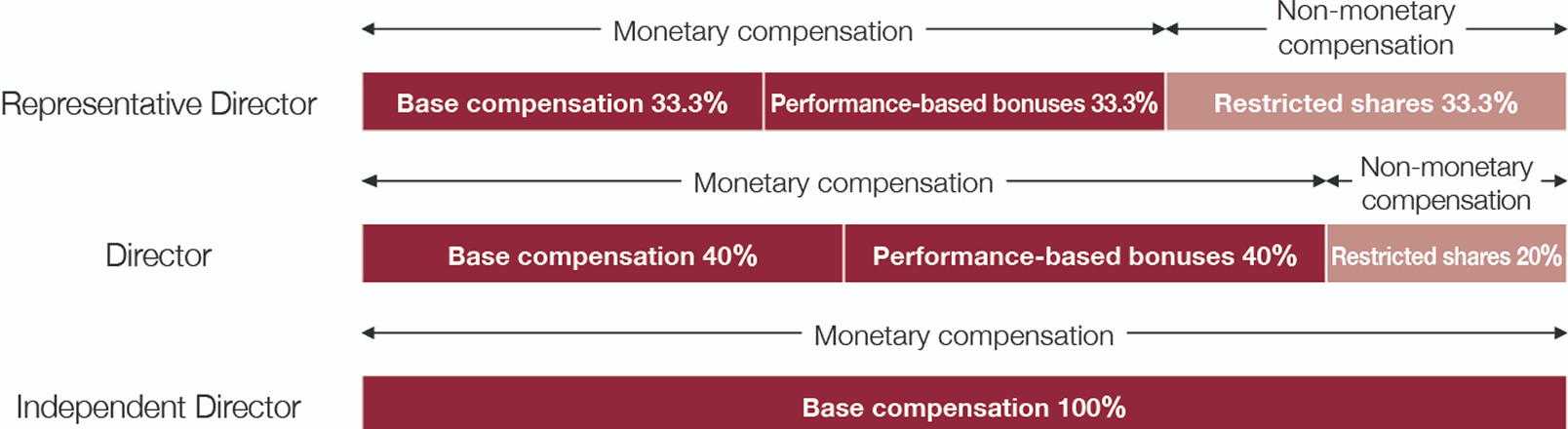
Ratio by Type of Compensation
The ratio of performance-linked compensation for directors of the Company increases the higher the position.
The ratio of base compensation, performance-based bonuses, and non-monetary compensation, etc., is shown in the table below assuming 100% of the target is achieved.
In addition, short-term incentive performance-based bonuses range from 0% to 200%, depending on the level of achievement. The percentage of long-term incentive non-monetary compensation varies from 30% to 100% depending on the level of target achievement.

Ratio by Type of Compensation

Related page

Corporate Governance Policy and System
Assessment of Effectiveness of the Board of Directors | Ryohin Keikaku Co., Ltd.